.png)

Building the largest fan-powered franchise in web3


CHARACTERs / IDS


NO - IDS

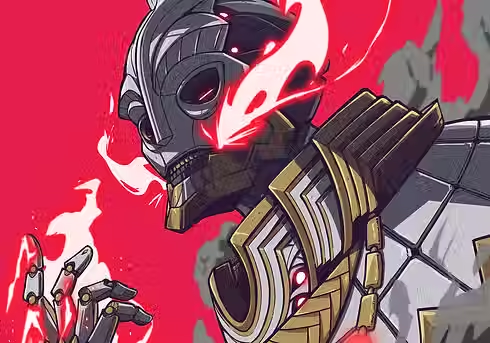


wanna know which id you belong to?

Mujin are respawned individuals whose memories never returned. With no personal history, no identity, and no attachments, they exist in a kind of emotional fog—functional, compliant, and quiet.They aren’t machines, but they’re often treated as if they are.
Most Mujin perform simple or repetitive tasks: labor, maintenance, delivery, service. They’re commonly found in restaurants, transport stations, and infrastructure zones, often displaying exaggerated politeness or cheerfulness—routines taught or reprogrammed into them to make others feel more at ease.
Even when alone, they stay in character. Not because they have to—but because there’s nothing inside telling them to stop.They live in the lowest tiers of Keshuma City, mostly in sleeping pod units designed for function, not comfort. These areas are rarely visited by citizens from higher levels.
Why does the system fear Mujin’s, and how does it depend on them?
Mujin reflect the deepest fear of the system: to live without memory, without identity, and without growth. Yet they also serve a vital function—supporting the city through work no one else wants to do, or is willing to do.
They’re used for dangerous jobs, where the risk of death or memory loss is high—because for a Mujin, being reset again doesn't change much. In some cases, they are even emotionally manipulated or modified to serve others in personal or entertainment roles.
Culturally, Mujin are seen as less. Not necessarily hated—but pitied, ignored, or dehumanized. Most citizens consider them safe, obedient, and harmless. Yet sometimes, a Mujin cries without knowing why—a feeling rises, unexplained and untraceable. There is still something human beneath it all.
Kodaka are system-breakers—rogue coders who manipulate the hidden code of Keshuma. They operate in secret, rewriting reality, unlocking forbidden layers, and creating temporary backdoors to escape the system’s control.
Kodaka symbolize rebellion through knowledge. They are idealists, cynics, and survivalists—each with their own view of truth. To be a Kodaka is to question everything… and act on it.
Even when alone, they stay in character. Not because they have to—but because there’s nothing inside telling them to stop.They live in the lowest tiers of Keshuma City, mostly in sleeping pod units designed for function, not comfort. These areas are rarely visited by citizens from higher levels.
What is their mission?
They sit above civic offices through hereditary Houses and an inner council that controls key system permissions. Policy is implemented as code: movement gates, resource allocation, surveillance thresholds, and emergency protocols. The Kaichukan serve as an enforcement and audit arm—nominally a check, functionally a partner. Public sentiment mixes awe and suspicion; access to Kodaka education is tightly restricted, keeping the class closed and elite.
Officially: preserve city continuity and safety. Practically: monopolize truth by controlling code—expand usable cache, define what’s real, and prevent destabilizing actors from writing at their layer. Long term, they pursue a master map of “reality rules” (through Academy research and under-city archaeocode expeditions) to keep Keshuma governable—and governed by them.

Citizens are the majority. They live within Keshuma City, go to work, follow protocol, and accept life as it is. Most never question the structure. Some suspect something’s off—but don’t want to know.
Citizens represent the default setting: survival through adaptation. Not everyone rebels. Not everyone escapes. But even here, there are moments of clarity—opportunities to wake up.
The Kaichukan are Keshuma City’s elite internal force. More than guards or soldiers, they’re a respected institution responsible for maintaining order, defending the city’s borders, and regulating internal movement.
Their influence runs deep. From their sprawling headquarters—complete with training grounds, watch towers, sleeping quarters, and a full command center—they oversee city operations and house their own educational program, one of the only structured learning systems available in Keshuma. Many citizens dream of joining, but entry is limited and highly selective.
Once inside, members form a tight, protective culture. They fight for control, for peace—and for each other.
To the Kaichukan, growth is something to manage carefully—not something to be rushed. Left unchecked, it can become dangerous—for the person, and for the system. They are loyal, disciplined, and believe that peace requires sacrifice. Whether that peace is real or manufactured depends on where you stand.
What do they protect against?
The Kaichukan represent order as a form of purpose. To many, they’re heroes—upholding safety in a world that constantly threatens to fall apart. They stand guard against outside dangers like the Kazegami, and track rogue coders like the Kodaka, who threaten to destabilize the system.
Their most critical—and least understood—responsibility is internal: They run the Final Bosu Prevention Branch.
This department monitors the growth paths of individuals and intervenes when someone nears the Maxline—the point where inner trauma could manifest as a Final Bosu. Through regulation, observation, and emotional support, they try to catch people before they cross that threshold. They even operate Support Centers, where citizens can voluntarily seek help before their growth spirals out of control.

Kazegami are outsiders—wandering survivors who live far from the city in forgotten ruins and open plains. Rooted in instinct and intuition, they avoid digital control and follow the wind—unmapped, unmeasured, and unclaimed.
Kazegami represent the raw side of growth: emotional, spiritual, and often untamed. They don’t resist the system through hacking or rebellion—
They simply step outside of it.
They follow their instincts.
They trust their path.
They listen to something deeper.
Something ancient.
Respawn (No-ID) refers to individuals who have been successfully resurrected through Metora, but somehow never arrived at Keshuma Station, the official terminal where all respawned are processed, tagged, and sorted.
They were born again, wrapped in red blankets like everyone else… But somewhere between Metora and the system’s grasp, they disappeared. They carry no identity, belong to no faction, and are not registered in any database. In the system’s eyes, they don’t exist.
These individuals are considered rogue anomalies, full of potential, but unmonitored and uncontained. With no memory, no Maxline, and no official integration, they move beneath the radar, unnoticed by most, but highly sought after by the Kaichukan, who consider them a threat to balance and order.
Some believe they escaped the system’s loop.
Others think they’re unstable, on the verge of collapse.
Whatever the truth is, no one knows where they are…
or what they might become.
Respawn Express Blanked
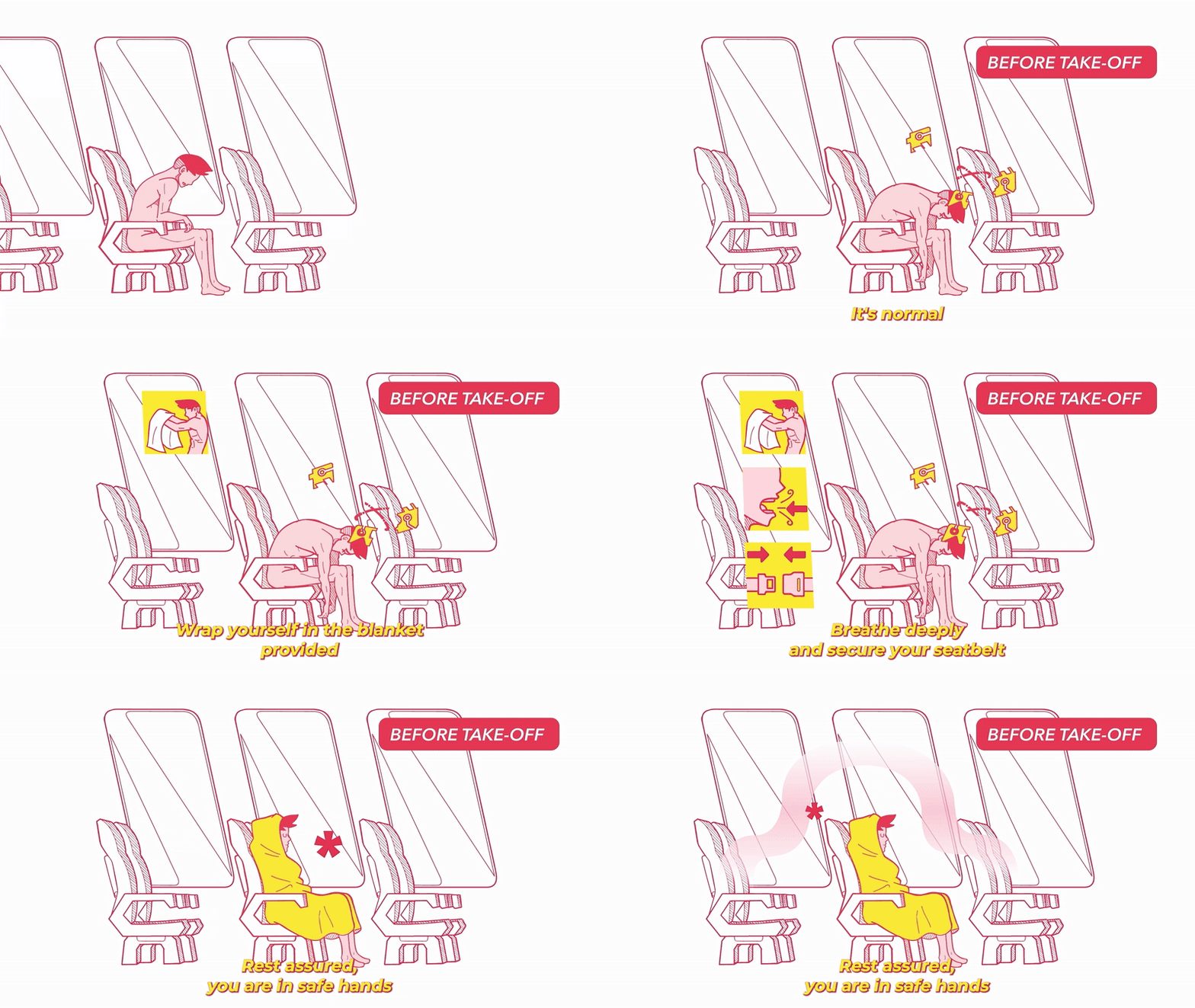
A standard red blanket issued to every newly respawned individual upon boarding the shuttle. It’s soft, synthetic, and warm—designed to reduce physical shock and stabilize body temperature. It also serves to cover their otherwise unclothed form.
The blanket is distributed uniformly and has become a recognizable symbol across Keshuma—a visual indicator that someone has just returned from Metora.

They don’t appear in the system. They carry no ID. And they aren’t supposed to exist.
There are rumors that these beings were once powerful Legacy Bosu who returned—reborn, but not through Metora. Some believe they resurfaced after crossing the Maxline. Others think they were never supposed to return at all.
No one knows where they came from. No one can confirm who they are. They don’t speak. They don’t register. And yet, some claim to have seen the same face in multiple places at once.
The system denies their existence. The Kaichukan avoid the topic. But the stories persist.