.png)

Building the largest fan-powered franchise in web3


METORA
Metora is a massive resurrection machine, standing alone in the center of a flat, shallow red lake. The water is calm and still, an eerie quiet that surrounds those who return.
When someone dies, their signal is drawn back to Metora. The machine begins reconstructing their physical form, based on data scattered through the system. Multiple bodies can be respawned at once, depending on how many lives were lost.
At no point is anyone clothed. They emerge naked, dazed, and vulnerable, cast directly into the red lake. Some awaken immediately, others remain unconscious until approached. No guidance is offered.
Metora does not erase memory, but it cannot always retrieve everything. What returns is partial fragmented, leaving the reborn in a state of confusion. They sense something missing… but not what.
Why is it there?
The true origin of Metora is unknown. Some whisper that it was left behind by a forgotten people to preserve life in an unstable world. Others believe it was a relic meant for a noble purpose, now hijacked by the very system it was supposed to protect against.
But in its current state, Metora has become a systemic loop: a place where death is not the end, but a reset. A reset with no reflection. No growth. Just return. And that is the tragedy.
Unlike traditional respawn systems in video games—where you come back and continue where you left off. Metora does not honor your past. It sends you back to the start without context, surrounded by a world that treats you as replaceable. Each return is a different experience. The passage of time, interference from others, or even memory corruption can alter how you come back, and who you come back as.
For those trapped in Keshuma, death is not an escape. It’s a cycle of near-eternal return. And if you’re unable to grow, if you're stuck repeating the same patterns, the same fate, with no access to your past then the loop becomes something far worse than death. It becomes a form of living purgatory.
experience it yourself

Metora embodies this tension:
Hope for rebirth. Fear of growth. The uncertainty of what you’ve lost.
Metora isn’t just a place, it’s a feeling.
Stillness. Disorientation. A second chance… but not the kind you asked for. Step into that space yourself, and feel what it's like to begin again—without knowing who you were.
A body being reconstructed within Metora

RESPAWN EXPRESS
The Respawn Express is a shuttle-like transport vehicle that carries newly resurrected individuals from Metora, a mysterious machine located in a red lake, to the edge of Keshuma City.
Wrapped in red blankets and stripped of their memories, passengers awaken confused and vulnerable—often unaware of who they are or what lies ahead. The shuttle is sleek, automated, and eerily efficient, operating with an unsettling blend of warmth and control.
Why is it there?
The Respawn Express is a shuttle-like transport vehicle that carries newly resurrected individuals from Metora, a mysterious machine located in a red lake, to the edge of Keshuma City.
Wrapped in red blankets and stripped of their memories, passengers awaken confused and vulnerable—often unaware of who they are or what lies ahead. The shuttle is sleek, automated, and eerily efficient, operating with an unsettling blend of warmth and control.
Respawn Express Safety Instruction Video
experience it yourself

Want to feel what it’s like to awaken in the red lake… confused, lost, and about to board the Respawn Express?
We created an interactive experience that lets you step into the journey yourself. Connect your X account, follow the hidden layers, and uncover what it means to enter Keshuma City.
Must complete Metora to unlock

GROWTH PATH
The Growth Path is a visible line that appears on the forearm of every respawned individual shortly after re-entry. It looks like a fine, etched system of lines or symbols that gradually extend as a person grows. Emotionally, mentally, or spiritually.
Though it resembles a tattoo or scar, the Growth Path is not static. It changes. It responds. And it tells a story, one that the system takes seriously.
Why is it there?

The Growth Path exists as part of the system’s way of regulating individuals after respawn. In a society where death is no longer permanent, the real threat is no longer dying, it’s what someone becomes after they come back.
Growth is framed as both necessary and dangerous. are encouraged to live stable, structured lives. Too much reflection, adventure, or emotional intensity can accelerate the path and push someone closer to a Final Bosu incident.
By making growth visible, the system has a tool to both guide and control behavior. It creates a quiet pressure on everyone to stay balanced, stay calm, and avoid reaching their limits.
But for those who still remember who they were…
Or those who feel something rising inside…
The Growth Path becomes more than a system.
It becomes a choice.
At the end of every path sits a symbol known as the Final Bosu icon. If someone grows too far, too fast, and reaches this point, it’s believed they may trigger a catastrophic event tied to deep unresolved trauma: the summoning of a Final Bosu.
To prevent this, individuals are instructed to monitor their path closely, and report to a Support Center if they notice rapid progression. In some cases, a Maxtag device is used to project a visible Maxline, a warning threshold meant to keep growth within “safe” limits.
The Growth Path is unique to each person, and while not everyone fully understands its meaning, everyone fears what happens when it goes too far.

maxtag

The Maxtag is a compact device folded into the tray table in front of each shuttle seat. When unfolded, it reveals an injector tool, a small pistol-like mechanism with a needle designed for self-administration.
Passengers are instructed to inject the needle of the Maxtag into their wrist, which activates a visible Maxline around the arm.

This line becomes part of the individual’s growth path, marking their current state and warning them when they begin approaching the threshold that could trigger a Final Bosu.
It is framed as a personal responsibility, a preventive measure to help individuals track and manage their own growth before it becomes dangerous.

final bosses
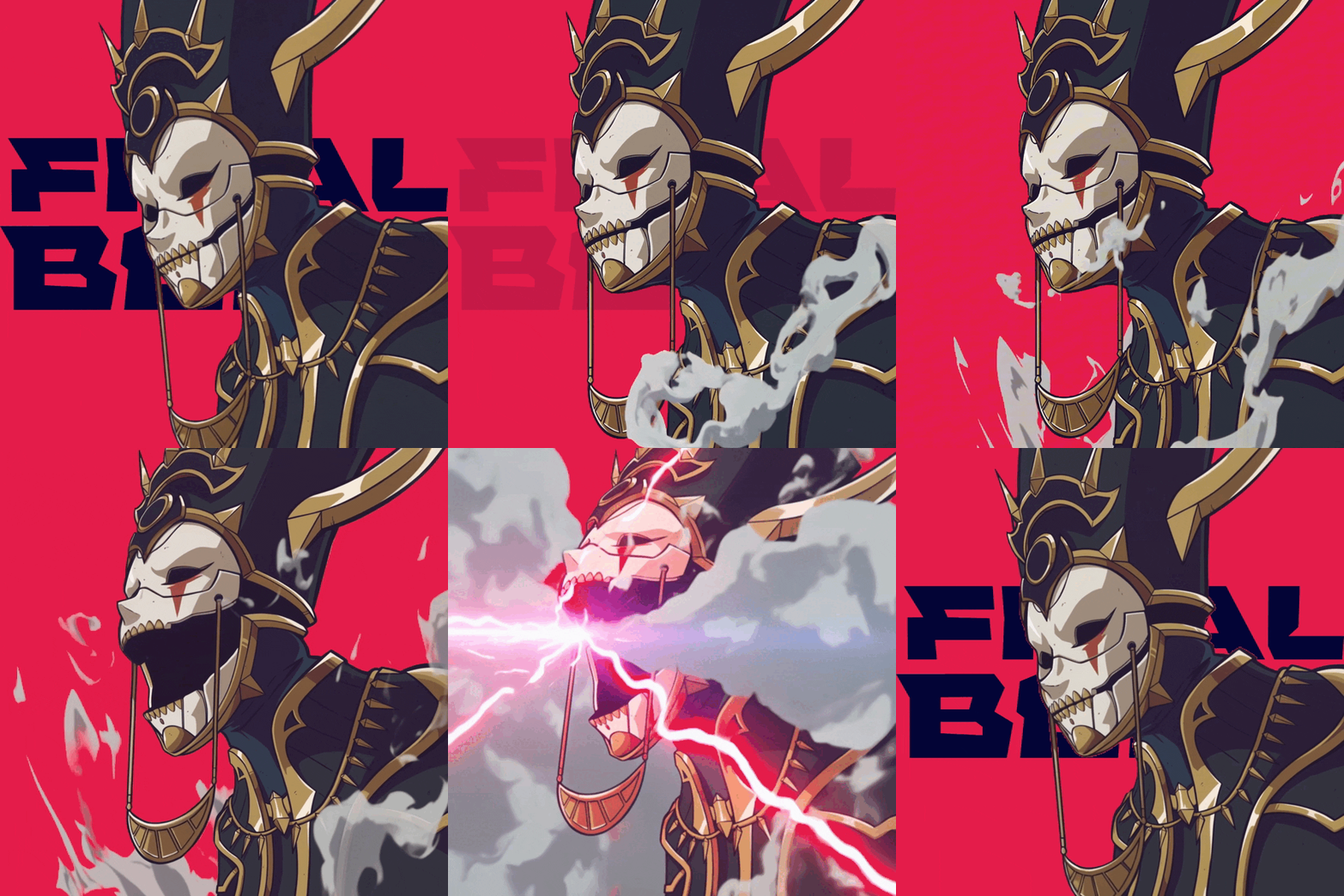
Ōgai王骸
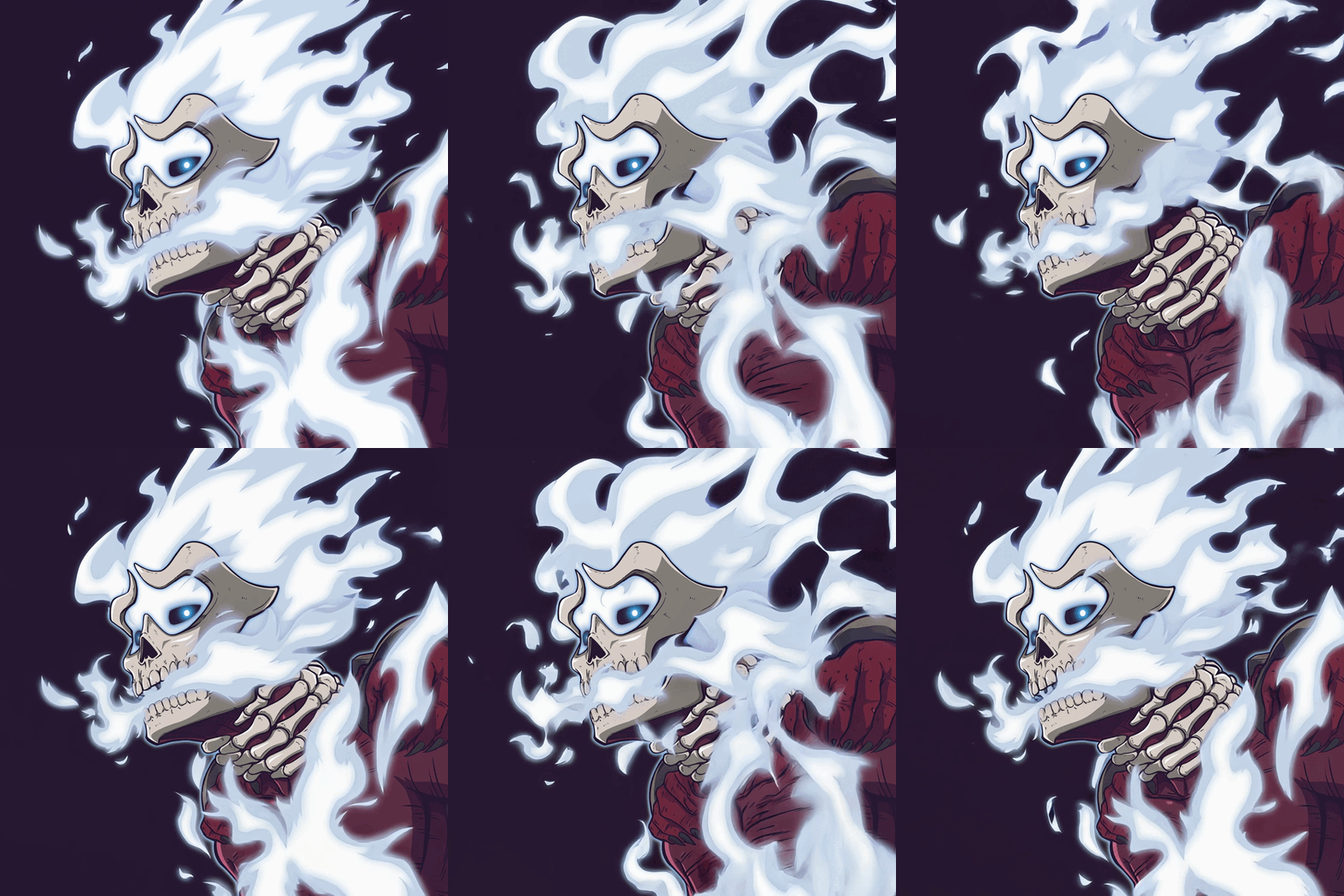
Aonibi青鬼火
animated by:

The Growth Path exists as part of the system’s way of regulating individuals after respawn. In a society where death is no longer permanent, the real threat is no longer dying, it’s what someone becomes after they come back.
Growth is framed as both necessary and dangerous. are encouraged to live stable, structured lives. Too much reflection, adventure, or emotional intensity can accelerate the path and push someone closer to a Final Bosu incident.
By making growth visible, the system has a tool to both guide and control behavior. It creates a quiet pressure on everyone to stay balanced, stay calm, and avoid reaching their limits.
But for those who still remember who they were…
Or those who feel something rising inside…
The Growth Path becomes more than a system.
It becomes a choice.
Why are they there?
In the world of Final Bosu, growth comes with a cost. The path forward demands confronting not just challenges in the outside world, but the deepest parts of yourself. The Final Boss is the ultimate trial, the point where all progress either solidifies into transformation… or collapses into ruin.
To defeat a Final Bosu is to overcome the very thing holding you back from true growth. It is liberation, rebirth, and ascension all at once. But failure means being consumed—body, mind, and memory—reset into the cycle once again.
Some whisper that the Final Bosses are part of the system itself, a built-in safeguard to ensure that only the rarest individuals break free. Others believe they are beyond the system’s control, a natural law of this world’s strange balance. Whatever their origin, one truth remains: no one transcends without facing theirs.

Hieroglyphs
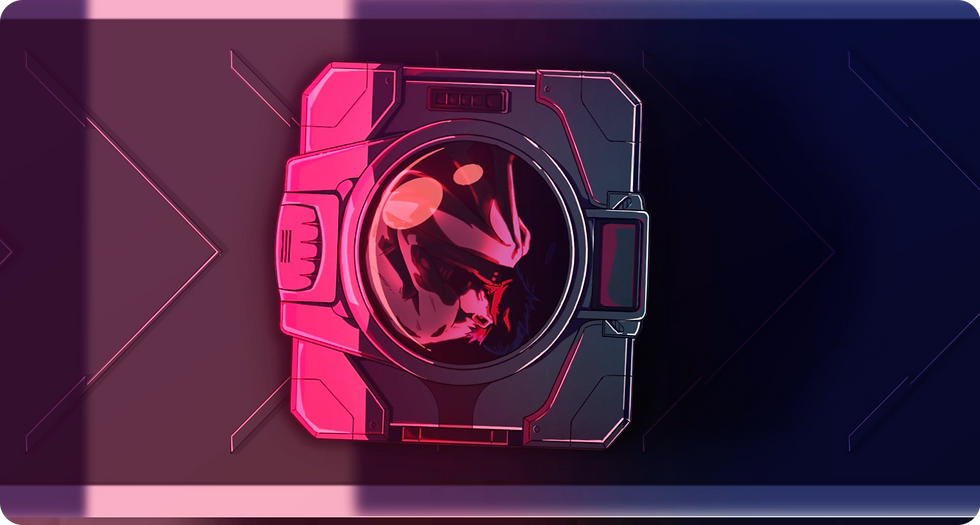
Hieroglyphs are ancient, undeciphered symbols found deep within the Hidden Legacy Catacombs, a secret network built inside the walls of Keshuma City. These markings are carved into old stone, etched into metal surfaces, and scattered across collapsed corridors that don’t appear on any official city schematics.
They do not match any known writing system. Some resemble glitched-out code fragments, others feel ritualistic or symbolic—like they were meant to trigger something, not just be read. The symbols often appear in mirrored patterns, repeating loops, or fractured sequences, suggesting an encrypted or multi-layered logic.
To this day, no complete translation exists. Every attempt has hit a wall.
WHY IS IT THERE?
Many believe these hieroglyphs predate modern Keshuma — possibly originating from the era, or even from a system that existed before the city was fully formed. Some theories suggest they were left behind by the original architects of the world—people who understood growth, memory, and identity in ways that are now buried or forbidden.

The ,especially those in deep-system recovery roles, have long searched for fragments of these symbols, often risking detection to uncover their meaning. A few claim that the hieroglyphs contain activation sequences, system backdoors, or instructions for reaching places that officially don’t exist.

Meanwhile, the deny their existence entirely. Any unauthorized discovery is quietly covered up or reassigned under unrelated labels. Internally, there are whispers that certain officers are tasked with actively sealing or erasing these symbols—not out of malice, but fear. Because if the symbols really do connect to something hidden in the system, it’s something the city may not be able to contain.
ARTEFACT
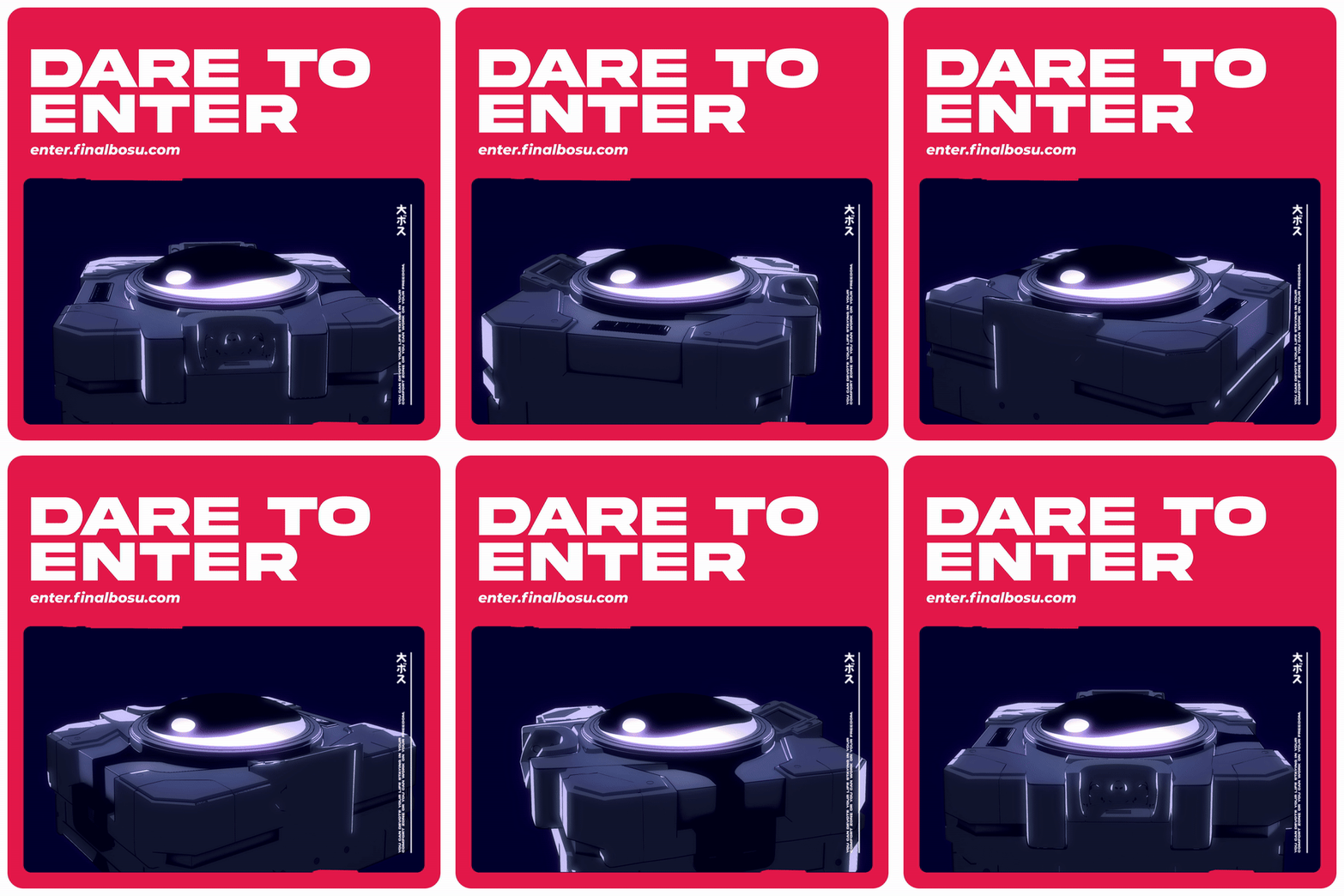
The Artefact feels almost alive, its presence radiating a quiet, unsettling intelligence. No one knows its origin or the era it belongs to, only that it bears a design unlike anything else in Keshuma: a compact, box-shaped form with strange buttons, a hand scanner, a carrying handle, an LCD-like display, and at its heart… a glass dome that glows to life at a single touch.
What happens next depends on the one who dares to activate it. Some are instantly rejected, their heads explode. Others are pulled inside, their bodies curled in a fetal position as if asleep, suspended in a silent incubation. From the outside, it looks like a bond is being formed—something deep and irreversible.
When the process ends, the user is ejected back into the world, but he’s changed. In their hands rests a suitcase. This isn’t just an object, it’s a living extension of them. It is linked to their DNA, carrying a power that can growth with them… a weapon. In the battles to come, it may be the only thing capable of standing against their Final Boss.
WHY IS IT THERE?
Its purpose is as mysterious as its design. Whispers claim the Legacy Bosu left it behind. An inheritance meant to arm worthy individuals with something no system could control. To those in power, the Artefact is dangerous, unpredictable… a threat to the fragile balance of Keshuma.
But to those who seek it, it is hope made tangible, a forbidden key to growth, memory, and identity in a world built to keep all three in check.
experience it yourself
Come face-to-face with the Artefact just like in the world of Final Bosu. From your perspective, its glass dome waits. Touch it, and the system decides your fate.
Will it accept you, syncing to your DNA and granting you a suitcase? Or will it reject you entirely? Only one way to find out.
Suitcases
CONCEPT ART (FAN ART ONLY)
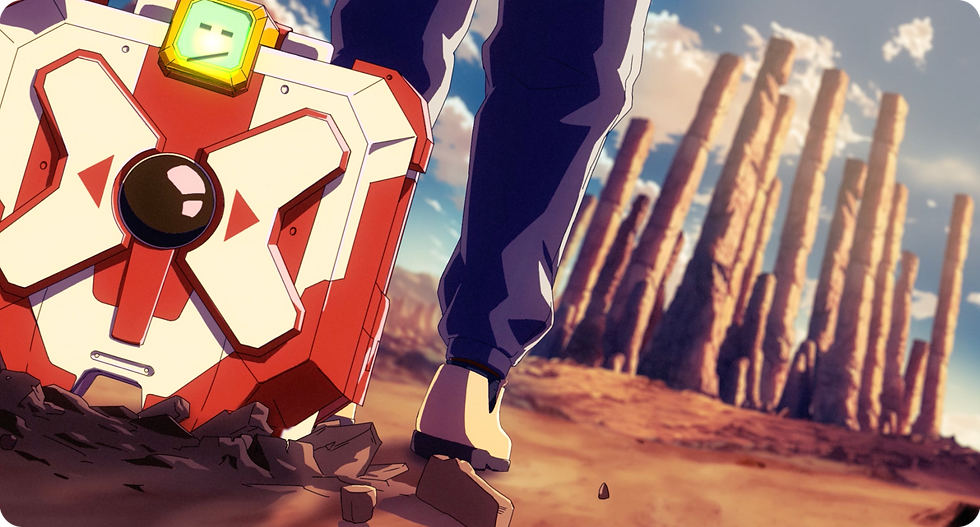
A suitcase is born the moment a person survives contact with the Artifact in the Hidden Legacy Catacombs. The Artefact incubates the user, bonds with them, and ejects them with a suitcase that is uniquely theirs. No two are alike.
Each suitcase adapts to its owner’s growth path and DNA, its form reflecting the individual’s personality and needs. From sleek briefcases to rugged backpacks, guitar cases, or even coffin-shaped carriers, their designs are as varied as the people who wield them. These appearances are not cosmetic—they are integral to the suitcase’s function and power.
Beyond their physical form, suitcases store memory backups and can return those memories after death—making them one of the rare tools capable of defying the city’s natural cycle of forgetting. Its true power activates the moment the bearer opens it, forging an unbreakable bond.
Every suitcase carries three key traits:
-
DNA Sync – Determines worthiness and unlocks the suitcase’s full potential.
-
Unique Design – Tied to the user’s identity, both in look and purpose.
-
Power Enhancement – Amplifies the user’s natural strengths, giving them the edge needed to confront their Finalbosu.
made by :


WHY IS IT THERE?
Its origin is tied to the same mystery as the Artefact. Many believe the Legacy Bosu left these devices as tools for those willing to walk the path of growth. They were never meant for the untested—only those who survive the Artefact’s trial can carry one.
To the system of Keshuma City, suitcases are dangerous. They preserve memory outside official control, allowing individuals to grow beyond sanctioned limits. A single suitcase in the wrong hands could destabilize the careful balance the city works to maintain.
To the bearer, however, it is more than a tool. It is a part of them — an extension of their identity, proof of survival, and a weapon against the impossible.